Tuesday, March 17, 2020

Rookie Gets His Picture in the Paper


The second installment of our special history focus this week, we look at how one player and a single game changed the way the local media handled the way it reported baseball!

Baseball has been a standard item in the news since the early days, offering information about players and teams of the area. While canvassing news reports of local games, the writings of Montgomery newsmen has been incredibly valuable.

The blunt and honest candor of reporters like Max Mosely, Stuart X. Stephenson, Sam Adams, Fuzzy Woodruff and others lay out the history as it happens. Their familiarity with Montgomery's baseball history - its players, coaches, executives and fans offers a view into the past of the city and its love affair with the game.


Another way the newspaper offers a view of the past is with its images. Finding a picture in the paper of a team or player wearing the Montgomery uniform is a treat for fans, then and now. However the printing techniques of the era were less than optimum for visual media so they tended to use few pictures.

 1904
Sometimes readers were offered an image of the league president or a team executive, in a format similar to this article in The Sporting Life about ownership of the Montgomery team.
Sporting Life Feb 1904


When Montgomery entered the Southern Association in 1904, the papers were happy to include the teams exploits in its columns. The Montgomery Advertiser, Alabama Journal and Montgomery Times had used their pages to cover the subject of base ball in print for over forty years. However excitement generated by a new ball club prompted typesetters to break their long standing print-only sports page format, offering an April image of the Montgomery infielders.


 That's it. No team photo appears in our local papers but there was one found in the Reach Base Ball Guide, which annually lists every team that can get nine guys to stand together long enough to take a picture.

Your 1904 Montgomery Senators aka Stickney's Pretzels

 This club started off badly and got worse as it went on. To say this was a bad year for the team would be a drastic understatement. It began even before the first game, as two groups wrangled for the Montgomery franchise, per the Sporting News article above.

Long time blog readers will recall some of the stories and players from this team, such as pitcher Duke Carter sleepwalking out of a third story hotel window and landing on the disabled list for the rest of the season.

Dropping quickly to the league cellar while playing at Highland Avenue Park, the best overall player on the Montgomery roster was Frank Delahanty. One of five brothers to play baseball at high levels, Frank Delahanty moved up to the major leagues after his oh-four Pretzels season. Three other of these Montgomery players either would get, or had already gotten, major league experience.

However it didn't help the Montgomery team in the standings and while games are well reported on in print no more photos of the team or its players appear on the sports pages in April or May.


So it was a surprise to everyone when, in June of 1904, an image appeared in the center of the sports page.


Gardner, Montgomery's new pitcher.

The new hurler, Gardner, shows up as the club is limping through its first pro season in five years. The youngster pitches an excellent debut, offering hope to the beleaguered Pretzels rotation. Three full columns are devoted to the rookie pitcher Gardner's first Pretzels game, a shutout, and much about how he can turn the team around for the second half.


And I'm thinkin "Who is this guy?"


RUBE GARDNER
Gardner with Oakland 1915
Luther Gardner hails from Tennessee, throws lefthanded and is listed as twenty years old in the lengthy article on the young hurlers debut contest.

Hailed by the local press as the savior of the team, the sportswriters missed the mark. This Rube notches just three more wins and loses fourteen games in the second half of the season. When not surrendering hits from the hillock, Gardner took a spot in the corner outfield so his .200 batting average could get into the lineup more often.

After Montgomery, Luther Gardner went on to play for a total of fourteen seasons, managing for short time in Seattle. Yet Luther "Rube" Gardner never pitched again after 1904. His ERA isn't recorded on baseball reference for that season, thankfully, and I won't reveal it either.

By the time Gardner's season in Montgomery closes, he is referred to as "utility outfielder Gardner". Luther Gardner opened the following year in Montgomery's outfield, then was dealt to Birmingham midseason where fans were frightened by talk of letting him pitch, which did not happen.

Luther went on to play with other teams, mostly on the west coast, but appears to have stayed off the center berm for good. Luther C Gardner passed away in March of 1953.

As it appears, Luther Gardner is the first Montgomery player to get his picture in the paper for his sparkling in-game efforts, changing forever the way media handles baseball news in Montgomery. And then he lost fourteen games and was never allowed back on a pitching mound again.

Monday, March 16, 2020

This Still Works - This Week in Montgomery Baseball History for Mar 14-20


This week, in the first of several history installments, we will focus on events of the past as we wait for what is to come. To help offset the lack of baseball, over the course of the week I will be posting several reports on my recent research and even offering up a contest!


THIS WEEK IN MONTGOMERY BASEBALL


MARCH 14 1906
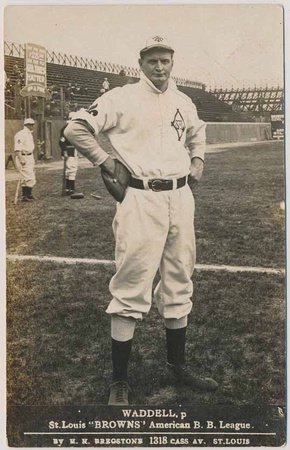
Word of Rube Waddell being attacked and robbed in Montgomery hit the papers.

While the star lefthander did have his wallet taken, it couldn't have been a big heist - manager Connie Mack knows better than to let the Rube have more than two dollars at once.

Rube reports the crime, then disappears again for a day before returning to the A's spring training workouts.


MARCH 15 1906 
The Montgomery ball club ownership hangs a $3ooo purse for its players to split as incentive to win the Southern league.
 1906 Montgomery captain Mullaney


MARCH 16 1921 
Big Sum offered for Montgomery's Steel Arm Dickey - its learned that Boston offered $5000 for the pitcher but is turned down.

Dickey remains and pitches for the Gray Sox as the ace of the team known as the "best colored outfit in the south"

Steel Arm Dickey


MARCH 17 1923 
The Philadelphia A's beat the Bham Barons 12-7 at Cramton Bowl in Montgomery.  


MARCH 18 1905 
Governor Cummings meets with the NY Highlanders as they hold spring training at Montgomery ... Sporting Life says that NY planned to break camp on the 18th, leaving for a game at New Orleans on the 20th.
1905 NY Highlanders player work out at Montgomery


MARCH 19 1908 
S.H.Smith, a student at Alabama Polytechnic Institute (Auburn Uni), who was struck on the back of the head by a thrown ball in a game on the 18th, dies without regaining consciousness.

Previously this was the only news source I had.
Since then I have found an article in the Birmingham News that offers more info on that tragic event.


MARCH 19 1908 
Philadelphia vs Montgomery, the Athletics soundly defeat the locals 11-1.


MARCH 20 1904 
Announcement comes that W.H.Raglan has bought Mgm team. Raglan is one of the heads of Montgomery street railway. The team would change hands again by the end of the following year.


MARCH 20 1911 
Thos. Kilby
Sunday Baseball Bill Goes Through
The Measure For Mobile is Passed by Senate By 12 to 11.

Bart Chamberlain’s Sunday baseball bill came to the senate and passed by nearly a tie vote of 12 to 11. Mr. Kilby speaking against the bill, compared the city of Mobile with Sodom and Gomorrah, and said the bill was an effort to repeal the Ten Commandments.


Monday, February 10, 2020

Shoeless Joe Comes To Montgomery


Joe Jackson, the shoeless White Sox outfielder banned for his knowledge of World Series game fixing, is an oft cited omission from the Hall of Fame.

The impression that most of us have of Joe after being banned from baseball is largely based on a single story - years after the Black Sox scandal, Ty Cobb found Joe running a small town liquor store and when Joe didn't acknowledge him Ty says "Joe, don't you know me?" to which Jackson replies "Of course I know you, Ty, but I wasn't sure if you wanted to know me".


Grantland Rice
Sportswriter Grantland Rice, known for his "elegant prose", knew how to spin a story. Not that this event didn't happen just as Rice wrote it, it could have. Probably. Sure it did, right?

That's the way much of Jackson's story goes, lots of stories spun into myth. With his career cut short, Joe Jackson left baseball wondering what could have been and trying to decide what actually had happened to one of the games greatest players.


LEADING OFF
Joe Jackson
The idea of Shoeless Joe walking away from the game entirely is a false one, just as much fiction as the "Say it ain't so, Joe" myth - also created by a sportswriter. The legends surrounding Jackson have become the larger part of his story, often implying that he sheepishly left baseball behind to slink back to the south and spent his days running shady pool halls and small town liquor stores while playing only under assumed names.


That Jackson himself appears to have thought Landis would readmit him is evident from every corner and seemed to be a foregone conclusion among most sportswriters of his era. He was acquitted of any crimes, of course.


WHAT THE HEADLINES SAY
Landis
Even after the Black Sox scandal, Shoeless Joe had opportunities to play in every league in the country and was often in articles on the verge of his next comeback. Joe Jackson would appear interested in joining teams, only to be disappointed when baseball commissioner Landis either refused to reinstate him or simply ignored Jacksons correspondence.


The southern press handles Jackson much differently than their fellow typesetters in the north, omitting the whole "banned from baseball" thing or portraying Jackson as on the verge of reinstatement. Jackson is mentioned often in articles connecting him with various clubs that have offered the star player a chance to stay in shape while waiting for the approval of Landis. In northern papers, Jackson is largely ignored and lumped with the other Sox conspirators.


PLAY BALL

Shoeless Joe Jackson at Cramton Bowl July 1924
  In fact, Shoeless Joe Jackson played often as an outfielder and manager for teams in Georgia and South Carolina. Unaffiliated and independent teams had no problem with improving their club and boosting attendance with a star such as Shoeless Joe. Commissioner Landis' ban had no reach to punish town teams, industrial leagues and barnstorming clubs. There Shoeless Joe Jackson easily found places to play ball.

By 1923, Jackson is with the Americus, Georgia semi-pro team. The Americus club is peppered with excellent talent of mostly southern players hired from area colleges, industrial leagues and smaller town teams. The addition of Shoeless Joe elevates Americus from being a good semi pro team to having a marketable product. They become barnstormers, making more money by playing exhibition games to larger crowds in bigger cities.
The 1923 Americus team with Joe Jackson

One of those cities is Montgomery.

In 1923 the Americus team came to town and faced off against a team from Blakely, Georgia. The game at Cramton Bowl was well promoted, with Shoeless Joe, the former Chicago White Sox outfielder billed as a star attraction. The city league game for that day was postponed so fans could watch Shoeless Joe Jackson on the field instead and the turnout was expected to be large.
The days game was so popular, it prompted a letter of complaint to the Bham News - someone was mad there weren't extra trains running to make sure all the fans in Birmingham could get to Montgomery to see Shoeless Joe Jackson play!

Cramton Bowl ca 1920s


SO NICE HAD TO PLAY AGAIN - TWICE!
The following year, 1924, Shoeless Joe Jackson was in Waycross Georgia with a railroad team called the Waycross Coast Liners when they played two games at Montgomery's Cramton Bowl.
1924 Waycross club with Joe Jackson

1924 game announcement
Again the games were billed with Shoeless Joe as the highlight, leading a southern All Star team playing local challengers. The games were held about six weeks apart, one being part of a doubleheader.

Regardless of the score or what action occurred on the field, Jackson's performance was what fans were watching. In one game at Montgomery, Jackson muffed a ball hit to him in centerfield and managed only a bloop single, yet observers all agreed he was a talented player who could return to the major leagues at any moment.

Nothing is said in any of the articles about the games about throwing games or accusations of any wrongdoing on Jackson's part.


JOE EXONERATED A SECOND TIME?
Shoeless Joe takes a swing at a game in 1922
Also in 1924, Joe Jackson sued White Sox owner Charlie Comisky for lost back pay in what was considered a re-trail of Jackson's part in the conspiracy to throw World Series games.

The jury sided with Jackson but the judge threw out the decision because Joe Jackson's testimony differed so greatly from his previous statements on the World Series fix. Jackson and Comisky settled out of court. 


ca 1926


SHOELESS JOE HIRED AS DOTHAN MANAGER


In 1926, Shoeless Joe was offered and accepted a job managing and playing first base for the Dothan team. Dothan was looking for a midseason boost and felt that bringing Jackson aboard would lift the clubs attendance as well as add power to the linup. Slated to take over for the July 4th homestand, Shoeless Joe was announced as the new skipper in the press.

First Jackson wired to say he would be late arriving, a day or two. Then he stopped replying to the teams cables. The Dothan team named a temporary replacement manager that eventually became permanent.

Later in the summer when it was learned that the club was seeking entry into a league that the Landis ban would be in effect, the Shoeless Joe in Dothan plan was scuttled entirely. What kept Joe Jackson from making that July 4th in Dothan is open to speculation.


HE WASN'T HIDING
Shoeless Joe with Savannah ca 1932
Joe Jackson moved to Savannah, GA with his wife immediately following the Black Sox scandal and stayed there off and on for the rest of their lives.

Shoeless Joe Jackson was known to be able to hit well into his fifties, though he put on weight as he aged, eventually moving from centerfield to first base. He appeared with many teams for local towns and companies, railroad teams and barnstorming All Star squads.

There was at least one instance of him playing under an assumed name that I found. It took exactly ten days for someone in a Texas bush league to recognize the guy hitting .485 as being the former Pale Hose batsman.
 

LATER
Joe Jackson at his store
 Joe also ran a dry cleaners and later, yes, a liquor store where the famous Ty Cobb meeting probably took place just as Grantland Rice told it. Jackson would occasionally give interviews but mostly stayed in town and enjoyed being a quiet part of the community over the next thirty years.

In 1951 the Cleveland Indians inducted Jackson into their team Hall of Fame. In December 1951 Shoeless Joe was invited to appear on Ed Sullivans "Toast of the Town" where many expected the announcement of Jackson's re-admittance to baseball. However, Joe Jackson passed away at home, two weeks before the event, at the age of sixty-four.